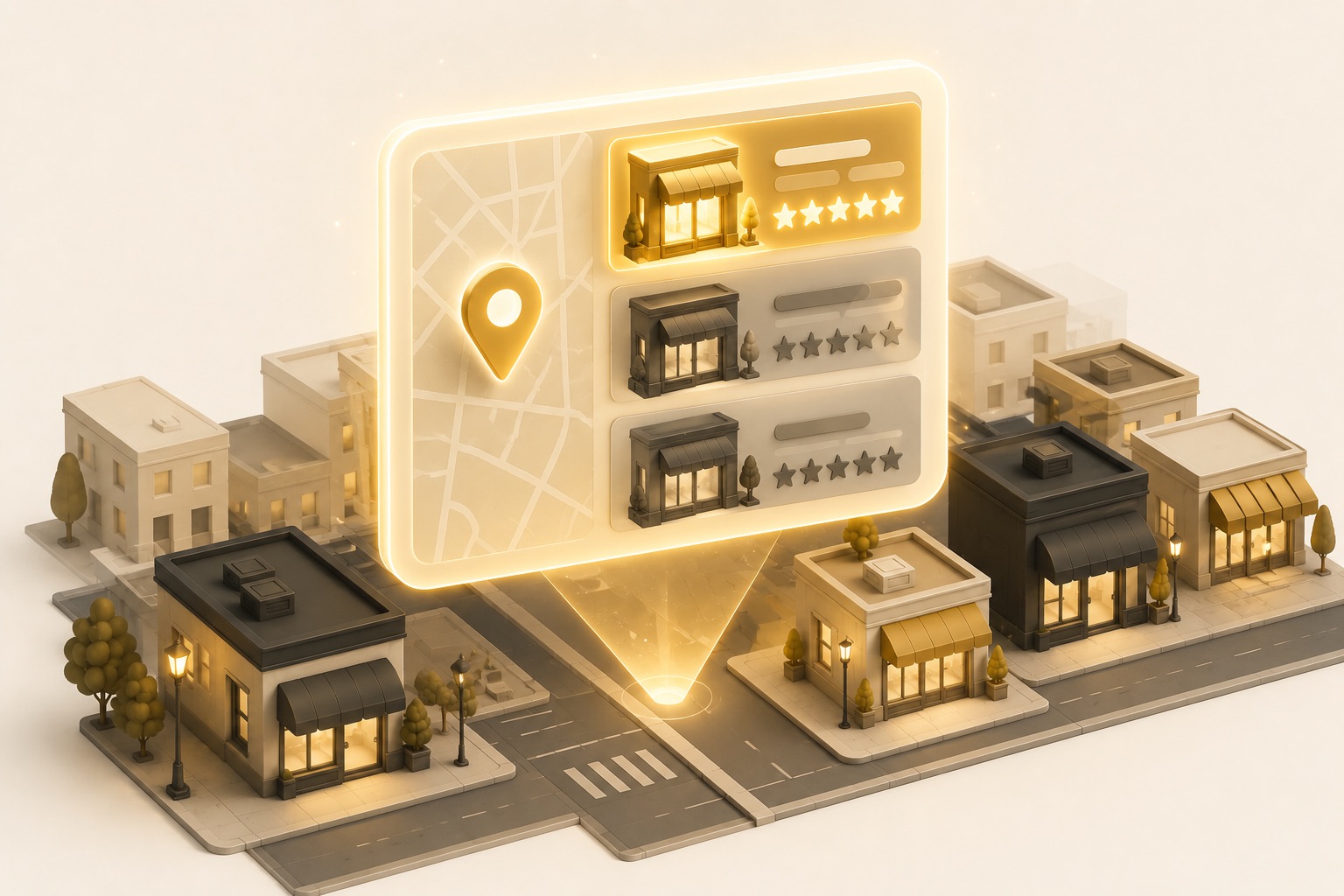
- The Map Pack is filled from Google Business Profiles, not websites — and profile signals drive roughly 32% of local rankings, making an incomplete profile the #1 reason businesses miss out.
- Reviews, consistent business details across the web, and a website that backs up your location are the next three levers — reviews alone carry about 16% of ranking weight.
- Fix the profile, the review gap and citations first — most businesses see movement within 60–90 days, and complete profiles are 2–3x more likely to appear at all.
You search your own service — "plumber near me", "dentist downtown Vancouver" — and there it is: three competitors in the map box at the top, and your business nowhere in sight.
That map box takes the majority of clicks and calls for local searches. If you're not in it, you're invisible to most of the people actively looking for what you sell — and the numbers on that are brutal: the top spot alone is estimated to take around 30% of all clicks, and 92% of searchers pick a business from the first page of local results. Falling out of the pack doesn't cost you some customers. It costs you most of them.
What is the Google Map Pack?
The Google Map Pack is the block of three local business listings — with a map, ratings and contact details — that Google shows at the top of results for local searches. It's powered by your Google Business Profile rather than your website, and it appears above the regular organic results for almost every "near me" or service-plus-city search.
That matters because local intent is enormous. Close to half of all Google searches have local intent, there are roughly 800 million "near me" searches every month in the US alone, and more than 80% of local searches now return a Map Pack. For most local businesses, this box — not your homepage — is the single most valuable piece of real estate on the internet.
Here are the five reasons we see most often when a business isn't ranking in it — roughly in order of how frequently they're the culprit.
How Google decides who gets in
Before the five reasons, it helps to know what Google is actually weighing. The 2026 local ranking-factor studies break the signals down roughly like this:
| Signal group | Share of ranking influence |
|---|---|
| Google Business Profile signals | ~32% |
| On-page website signals | ~19% |
| Review signals | ~16% |
| Link signals | ~15% |
| Behavioral signals | ~8% |
| Citation signals | ~7% |
Two things follow from this. First, your Google Business Profile alone drives about a third of the result — which is why four of the five reasons below trace back to it. Second, Google now evaluates your business as a single connected entity, weighing profile, reviews, website and mentions together. One inconsistency anywhere quietly drags down everything else.
1. Your Google Business Profile is incomplete
Google fills the Map Pack from Google Business Profiles, not websites. A profile missing categories, services, hours, photos or a description gives Google very little to rank you with — and the penalty is measurable: complete, active profiles are 2–3 times more likely to appear in the Map Pack than incomplete ones.
There's also a decay problem most owners don't know about. In 2026, profiles that go quiet for 30+ days — no new post, no fresh photo — measurably lose visibility. Google reads silence as irrelevance.
The fix is unglamorous but effective:
- Choose the most specific primary category available — "Emergency plumber", not "Plumber", if that's your bread and butter. Category selection is the single biggest on-profile ranking lever there is; switching to a more precise one often moves visibility more than any other edit.
- Fill in every secondary category that genuinely applies.
- List your services individually, with descriptions.
- Add photos regularly — and make them real. As one practitioner put it in r/localseo's most-upvoted thread this month: "stop uploading polished stock photos to your GBP — Google's vision AI knows exactly what a stock photo looks like, and it strips away all your local relevance." Raw smartphone shots of your actual team and jobs beat glossy stock every time.
- Post something weekly. Fifteen minutes keeps you out of the decay zone.
2. You have fewer (or worse) reviews than the businesses ranking
Reviews carry about 16% of ranking weight — and they're also your single strongest conversion signal. If the three businesses in the pack have 150+ reviews and you have 12, that gap is doing a lot of the damage on both fronts.
But it's not just the count. In 2026, velocity beats volume: a steady flow of reviews every month outranks a one-time burst of 50 followed by silence, because Google reads the pattern, not just the total. And there's a compounding benefit — around 150 reviews is also the point where AI assistants like ChatGPT start naming businesses in their recommendations, so the review engine you build for the Map Pack pays off in AI search too.
You don't need to beat competitors overnight. You need a system: ask every happy customer at the moment they're happiest, make it a one-tap link, and reply to every review — including the bad ones, which convert more readers than a wall of perfect fives. Our full playbook on how to get more reviews on Google covers the compliant way to build that system.
3. Your name, address and phone number don't match across the web
Google cross-references your business details everywhere they appear — directories, social profiles, your website. If you're "Smith & Sons Plumbing Ltd." in one place, "Smith and Sons" in another, and an old address is still floating around on Yelp, Google's confidence in your listing drops.
This is what the industry calls entity fragmentation: a single address or phone-number variation across directories can make Google stop fully trusting your business data, and Map Pack visibility drops across the board. The usual culprits are old addresses and tracking numbers left behind by past marketing agencies. Consistency is boring, but it compounds — pick one canonical format for your name, address and phone, then fix every listing to match it.
4. Your website doesn't back up your location
Your Google Business Profile and your website work as a pair. On-page signals carry roughly a fifth of local ranking weight (one analysis puts traditional on-page factors at about 24% of the local algorithm), so a thin site quietly caps how high your profile can climb.
If your site never mentions the neighbourhoods you serve, has no embedded map, and buries your phone number, you're giving Google no reason to connect you to local searches. A strong location page — service areas, directions, local proof, an embedded map, your NAP in the footer — does more than most people expect. (Our Vancouver local SEO page shows the pattern in practice.)
5. You're competing from the wrong part of town
Map Pack results are heavily distance-weighted: Google favours businesses physically close to the searcher. If your shop is on the edge of the city, you may never crack the pack downtown — that's proximity math, not a mistake you can fully optimize away.
The move is to own what you can. You'll dominate the Map Pack in your immediate area, and capture the neighbourhoods you can't reach through service-area pages that rank in regular organic results below the pack. Don't burn budget trying to force the pack in a part of town you're physically far from; win your radius, then expand outward with content.
How to check where you actually rank
Here's the mistake that makes owners think they're fine when they're not: they search their own service on their own phone, see themselves near the top, and relax. Google personalizes results to your location, your history, and the fact that you visit your own listing constantly — so you always look better to yourself than to a stranger across town.
To see the truth, use a grid-based rank tracker (Local Falcon and similar). Instead of one check, it pulls your Map Pack position from dozens of points spread across your service area and shows the result as a heat map — green where you're in the pack, red where you're not. Almost every business is shocked the first time: #1 next to the shop, invisible three kilometres away. That map tells you exactly where the work is, and it's the single most clarifying thing you can do before spending a dollar on local SEO.
Where to start
Don't try to fix all five at once. In our experience the fastest wins, in order, are: complete the profile (category first), close the review gap, then tighten up citations. Those three account for the bulk of the algorithm, and most businesses see meaningful movement within 60–90 days of doing just them properly — sooner in low-competition suburbs, longer in dense, competitive city centres.
When you're ready to go past these five fixes, our complete guide to local SEO in 2026 walks through the whole system in order — and if you'd rather have it done for you, that's exactly what our local SEO service is.
Frequently asked questions
What is the Google Map Pack?
The Google Map Pack (or Local Pack) is the block of three local business listings with a map that appears at the top of Google results for searches with local intent. More than 80% of local searches trigger one, and it's powered by Google Business Profiles, not websites.
How long does it take to rank in the Map Pack?
For most businesses with a solid foundation, meaningful movement takes 60–90 days. Competitive industries and dense city-centre areas can take longer. The fastest wins come from completing the profile, closing the review gap, and fixing citation inconsistencies first.
Do I need a website to rank in the Map Pack?
Technically no — but in practice a website that confirms your location, services and service areas significantly strengthens your profile. On-page signals account for roughly a fifth of local ranking weight, and your site is where searchers land after they find you in the pack.
How do I check where I actually rank in the Map Pack?
Don't search from your own phone — Google personalizes results to your location and history, so you'll see yourself higher than a real customer does. Use a grid-based local rank tracker (Local Falcon and similar) that checks your position from dozens of points across your service area. Rankings vary block by block, so a single check from your desk tells you almost nothing.
Why do I rank in one neighbourhood but not another?
Map Pack results are heavily distance-weighted — Google favours businesses physically close to the searcher. It's normal to rank #1 near your address and drop out of the pack a few kilometres away. You own your immediate area through the profile, and reach the rest through service-area pages that rank in regular organic results.

Founder of Lead Local SEO, a Vancouver-based local SEO agency helping local businesses top Google Maps, local search and AI results.
More about Michael →We handle all of this for local businesses — every day.
Get a free audit of where you rank on Google Maps, search and AI — and a clear plan to get you to the top.
Get My Growth Plan →